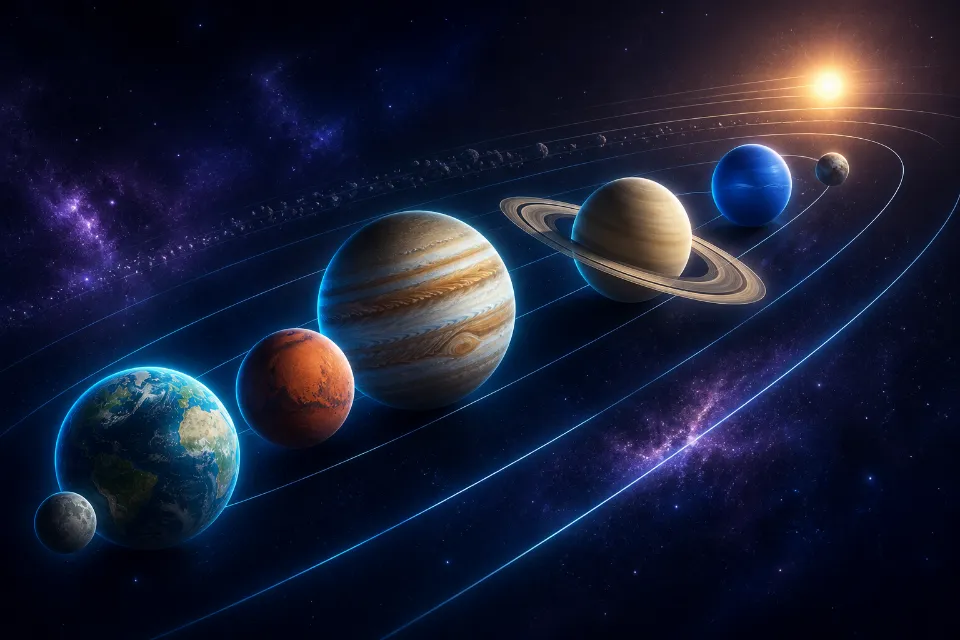
Planets are progression milestones, active play spaces, and cumulative bonuses in Planet Clicker. A new world is never only a cosmetic swap. It changes offline income, critical rewards, purchase prices, production, event value, or pick strength. The Solar System screen lists exact requirements, so the most efficient route is to work on the unfinished condition closest to completion.
How Planet Clicker Planet Requirements Work
Most Planet Clicker planets require four kinds of progress: available Energy, Earth level, total generators, and claimed missions. The Energy price is spent when you unlock the world. Other conditions are milestones and are not consumed. A green check means that requirement is complete.
Open the Planet Clicker planet screen before a large purchase. If a fixed unlock price is your only missing condition, buying MAX in another category may delay exploration. If the generator count is missing, inexpensive units can be more useful than one building with high output. If Earth level lags, spend a focused session building combos.
Planet Clicker Earth: The Starting World
Planet Clicker Earth begins at level one and has no unlock price. Its bonus adds ten percent to Solar Panel production. That sounds modest, but Solar Panels dominate the opening and help satisfy early building requirements. Continue picking Earth even after automation begins because its level gates every later planet.
Planet Clicker planet experience comes from picks, with a small benefit from longer combos. Generator production does not level Earth by itself. Players who prefer idle progress should schedule occasional active bursts to prevent Earth level from becoming the only unfinished requirement.
The Planet Clicker Moon: Better Offline Earnings
The Planet Clicker Moon is the first destination. It asks for a small Energy reserve, Earth level three, and four total generators. Its ten percent offline bonus begins teaching the value of returning later. Unlocking it also provides a new planet to level without deleting Earth progress.
Use mostly Planet Clicker Solar Panels to satisfy the building condition because they are inexpensive and Earth improves them. Save the listed Energy when the level and generator checks are complete. The beginner’s guide gives a precise opening route to this point.
Planet Clicker Mars: Terraform Active Power
Planet Clicker Mars requires a larger Energy reserve, Earth level five, ten generators, and two claimed missions. Its terraforming bonus raises pick output by fifteen percent. Active players feel the improvement immediately, and critical or combo rewards benefit because they multiply a stronger base.
Do not ignore the Planet Clicker mission condition. A finished mission only counts after you claim it. If two missions are not available, review the objectives for picks, Solar Panels, and lifetime Energy rather than waiting without a plan.
Planet Clicker Venus: Stronger Critical Rewards
Planet Clicker Venus raises critical rewards by twenty five percent. It requires Earth level eight, twenty two generators, three claimed missions, and its Energy price. The bonus combines well with Mars because Mars improves the base value before a critical multiplier is applied.
At this Planet Clicker stage, diversify beyond Solar Panels. Energy Stations and Satellites can improve production efficiently, while inexpensive panels may still be useful for reaching the exact generator total. Check the upgrade and generator guide before committing the unlock reserve.
Planet Clicker Mercury: Lower Upgrade Costs
Planet Clicker Mercury reduces click upgrade costs by five percent. The savings grow as Quantum Touch and higher tiers become expensive. Its conditions rise to Earth level twelve, forty generators, four missions, and a substantial Energy balance.
If Planet Clicker Mercury is close, delay a large click upgrade batch until after unlocking it. The discount applies to future purchases, including bulk quantities. Generator costs are not affected; Uranus handles that part of the economy later.
Planet Clicker Jupiter: Atmospheric Gas Production
Planet Clicker Jupiter adds twenty percent to overall passive production. Its large multiplier makes every owned generator stronger, so it can be worth preserving the unlock cost rather than purchasing one more building tier. Requirements include Earth level seventeen, sixty five generators, and five claimed missions.
The production jump helps the run move from millions toward larger unlock prices. It also raises offline earnings because those are calculated from Energy per second. Jupiter therefore supports both continuous and returning play styles.
Saturn: Ring Mining Rewards
Saturn improves asteroid rewards by twenty percent. Reach Earth level twenty three, own ninety five generators, claim six missions, and reserve the required Energy. The bonus combines with Mining Ship and the permanent Asteroid Rewards skill.
Asteroids scale with your economy, so the percentage remains relevant. A golden event after Saturn can produce a particularly strong cache. Events are still optional; missing one never removes existing progress.
Uranus: Generator Discounts
Uranus reduces generator costs by eight percent. The effect is valuable because advanced buildings use steep price curves. Earth level thirty, 130 generators, and seven claimed missions establish that you have already built a serious automated network.
As with Mercury, wait to make a large relevant batch purchase if the world is nearly available. Uranus stacks with Building Discount ranks, allowing production late in the game to expand for less Energy.
Neptune: Deep Ice Pick Energy
Neptune multiplies pick power by thirty percent. It arrives at Earth level thirty eight, 175 generators, eight missions, and a high Energy price. The bonus makes Cosmic Touch, combos, and criticals more competitive with advanced automation.
Neptune is particularly useful when asteroid health has scaled upward because asteroid damage uses current pick power. The world gives active play another strong phase late in the run.
Pluto: Additional Stardust
Pluto is the final standard Solar System destination. It requires Earth level forty eight, 230 generators, nine missions, and a large Energy reserve. Its bonus adds one Stardust when qualifying game rewards grant Stardust, strengthening prestige and valuable event outcomes.
Because Stardust survives Galaxy Reset, Pluto’s advantage reaches future runs. Consider completing nearby Stardust missions and watching for a golden asteroid before resetting if the extra permanent resource justifies the wait.
Conclusion
Planet progression is easiest when every destination has a purpose. Review the full requirement list, strengthen the systems that are holding you back, and avoid spending all your Energy before an important unlock. Each new world should improve the economy you already built rather than replace a clear plan with another grind. Open the Solar System in Planet Clicker, find the first incomplete requirement, and make it your next objective. For broader planning, read the tips and strategies guide or review how every Planet Clicker system works.
The Planet Clicker planet route rewards preparation more than random spending. Complete the closest requirement, reserve the listed Energy, and use every cumulative world bonus to strengthen the next stage. A clear destination turns a large Solar System into a manageable sequence.
Related Guides

Beginner’s Guide
Reach the Moon efficiently.
Read Guide →
Best Upgrades
Build toward each requirement.
Read Guide →
Tips And Strategies
Plan progress from one milestone to the next.
Read Guide →